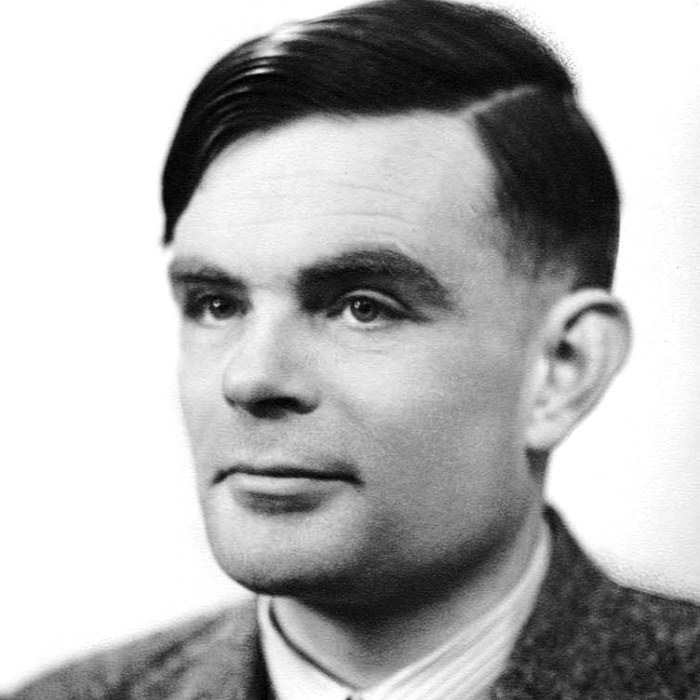
Alan Turing
Father of computer science whose codebreaking helped shorten the Second World War
Alan Turing was an awkward, brilliant schoolboy who taught himself advanced mathematics and was often marked down for untidy handwriting. At 24, while at Cambridge, he wrote a paper describing an imaginary machine that could carry out any computation by following instructions on a tape. The "Turing machine" is still the theoretical basis for every computer built since.
During the Second World War he worked at Bletchley Park, the secret codebreaking centre. He designed the "bombe", an electromechanical machine that searched for the daily settings of the German Enigma cipher, and led the section attacking naval Enigma, which protected the U-boats sinking Allied convoys in the Atlantic. Historians estimate the work at Bletchley shortened the war by two years or more.
After the war he designed one of the first stored-program computers and wrote a paper asking whether machines could think, proposing the test that now bears his name. He was also a serious distance runner, coming close to Olympic marathon standard.
In 1952 he was prosecuted for a relationship with another man, which was then a crime in Britain. He accepted chemical castration rather than prison, lost his security clearance and died two years later from cyanide poisoning. The British government apologised in 2009, he was pardoned in 2013, and in 2021 his face was put on the £50 note.