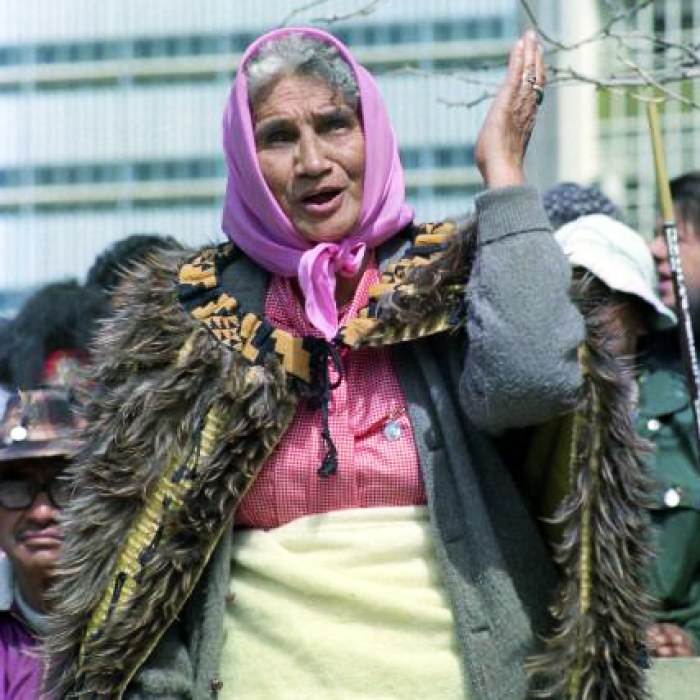
Whina Cooper
At 79 she walked the length of the North Island to tell Parliament: not one more acre of Māori land
Hōhepine Te Wake was born at Te Karaka, on the Hokianga harbour, the daughter of a Te Rarawa leader who taught her the history and land claims of their people. At eighteen she led her first protest, organising a group to fill in the drains a Pākehā farmer had dug to claim the mudflats where her community gathered shellfish. She worked as a teacher, then ran a store and a farm, and became a figure of some authority in the north, organising land development schemes and building a meeting house.
In 1949, widowed for the second time, she moved to Auckland, and in 1951 was elected the first president of the Māori Women's Welfare League, which she built into a national organisation concerned with housing, health and the growing numbers of Māori moving to cities. She was blunt, autocratic and hard to work with, and stepped down in 1957 after quarrels with the executive.
She was 79 and had been retired for years when younger activists asked her in 1975 to lead a march against the continuing loss of Māori land. On 14 September about fifty people set out from Te Hāpua, at the top of the North Island, under the slogan Not one more acre. She walked with a stick, and often had to be driven, but she was at the front when the march reached Parliament in Wellington a month later with around five thousand people and a petition of 60,000 signatures.
She was made a Dame in 1981, and became known as Te Whaea o te Motu, the mother of the nation. She died at Panguru in 1994, aged 98.