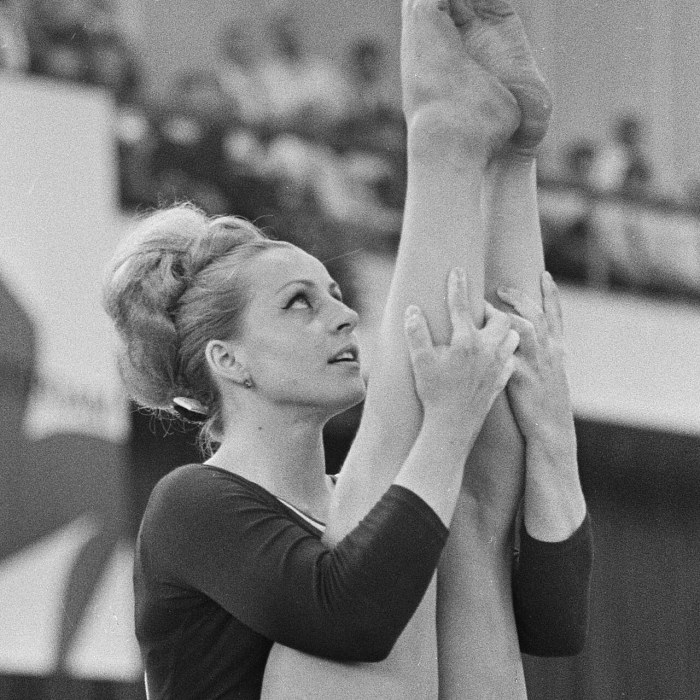
Věra Čáslavská
Hid in the woods after the Soviet invasion, won four golds in Mexico and turned away from the anthem
Věra Čáslavská started as a figure skater in Prague and switched to gymnastics at 15. She was the dominant gymnast of the 1960s, winning three golds at the Tokyo Olympics in 1964, and by 1968 she was the reigning world and European champion. That summer she signed the Two Thousand Words, a manifesto calling for the reforms of the Prague Spring to continue.
In August Soviet tanks rolled into Czechoslovakia. Warned she might be arrested, she went into hiding in the mountains near Šumperk, where she kept training with what was to hand: swinging from tree branches, lifting sacks of coal, practising her floor routine in a meadow. She was given permission to travel to the Mexico City Olympics only at the last moment.
There she won four golds and two silvers. On the podium for the floor exercise, where the judges had controversially given a tie with a Soviet gymnast, she turned her head down and away while the Soviet anthem played. It was a silent gesture and the whole world saw it. She married the runner Josef Odložil in Mexico City in front of thousands of people, and went home.
She refused to withdraw her signature from the manifesto and was punished. She was barred from coaching, from travelling and from public life for most of the next 20 years. After 1989 she became an adviser to Václav Havel and president of the Czech Olympic Committee. Her later years were marked by family tragedy and depression. She died in 2016.