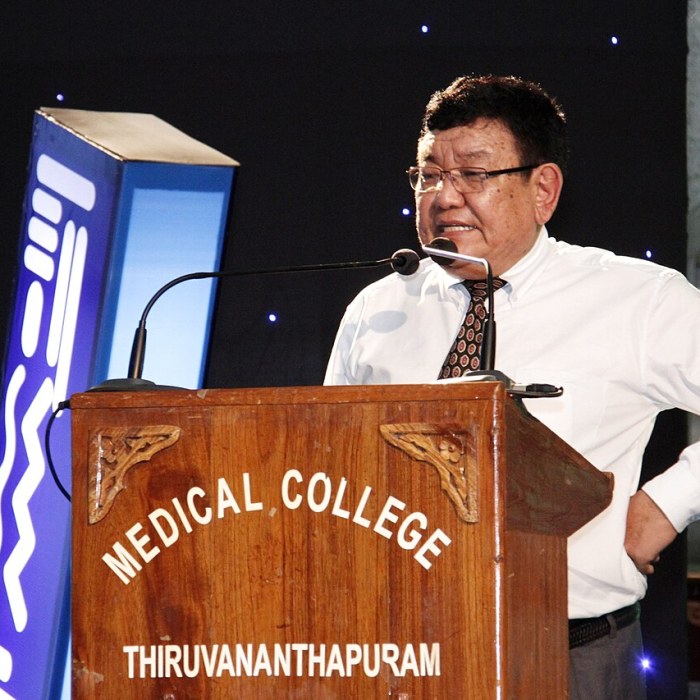
Sanduk Ruit
Walked eleven days to school from a Himalayan village and made cataract surgery cost a few dollars
Sanduk Ruit was born in 1954 in Olangchung Gola, a village of salt traders in the far north-east of Nepal, close to the Tibetan border, with no school, no doctor and no road. His father sent him at seven to a school in Darjeeling, a walk of about eleven days. His younger sister Yangla died of tuberculosis in her teens, a death he later described as the reason he became a doctor.
He studied medicine in Lucknow and ophthalmology in Delhi and came back to Nepal to find that cataract, a condition that a twenty-minute operation could cure, was blinding people by the hundreds of thousands because the surgery and the lenses were beyond their means. In 1986 he met Fred Hollows, the Australian eye surgeon, and the two men became close; Hollows was convinced that Ruit could reach people no foreign team ever would.
Ruit worked out a small-incision technique that needed no stitches and no expensive machine, and could be done quickly in a tent, on a table, by lamplight. Trials showed results as good as the Western standard at a fraction of the price. In 1994 he opened the Tilganga eye centre in Kathmandu, and the next year a factory beside it that makes intraocular lenses for a few dollars each and exports them across the developing world.
He has personally performed well over a hundred thousand operations, many of them in mobile camps in the mountains. He received the Magsaysay Award in 2006.