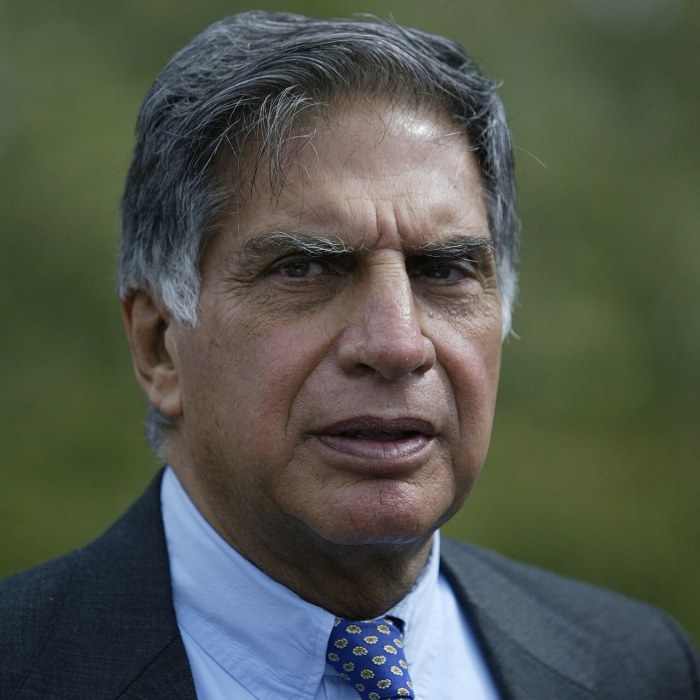
Ratan Tata
Trained as an architect on a construction site before turning around the company his family founded
Ratan Tata was born in Bombay in 1937 into the family that had founded India's Tata Group generations earlier, but his own parents separated when he was young and he was raised largely by his grandmother. He studied architecture at Cornell in the United States, supporting part of his costs with part-time jobs, before returning to India in 1962 to join the family firm not in an executive suite but on the shop floor, shovelling limestone at a Tata steel plant and later working in a factory making truck bodies.
He spent years in unglamorous operational roles across the group's many companies before being asked in 1991 to take over as chairman of the whole conglomerate, then a loose collection of businesses run semi-independently by powerful individual chief executives who often ignored head office. Tata spent years imposing common standards, retiring several entrenched leaders, and pushing the group toward more disciplined, centrally coordinated growth.
Under his leadership Tata Group expanded internationally, buying Jaguar Land Rover and the steelmaker Corus, and launched the Tata Nano, an attempt to build a genuinely affordable car for Indian families, a project that struggled commercially but reflected his long-standing interest in serving ordinary customers rather than only the wealthy.
He was known for personally responding to public complaints and for insisting that Tata companies maintain strong worker welfare and disaster relief programmes, a continuation of the paternalistic tradition his ancestors had established. He never married and largely avoided personal publicity, dying in 2024 widely regarded as one of India's most trusted business figures.