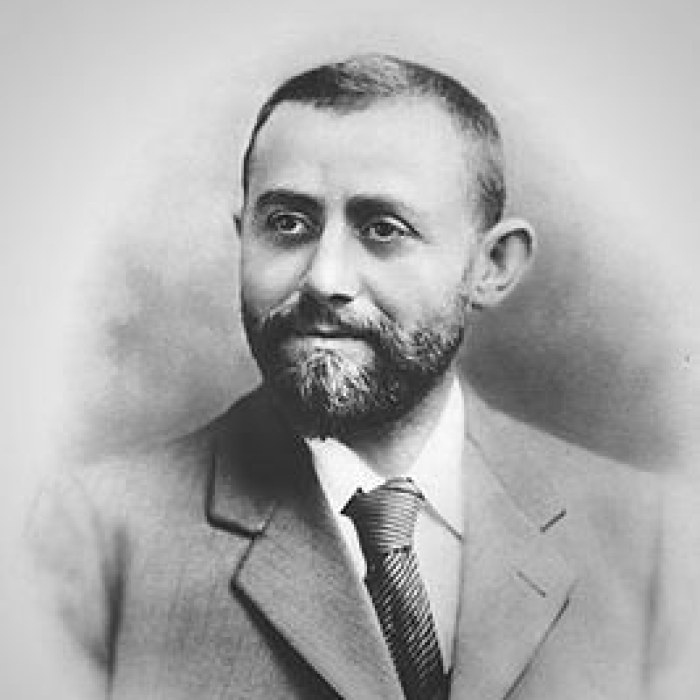
Michael Marks
A refugee pedlar with no English whose market stall became Marks & Spencer
Michael Marks was born in 1859 in Slonim, a town in what was then the Russian Empire and is now Belarus, to a poor Jewish family. Like many young men facing poverty and persecution there, he left, arriving in the north of England around 1882 with little money and no English.
In Leeds he found a wholesaler, Isaac Dewhirst, who was willing to lend him five pounds' worth of goods. Marks hawked buttons, wool, needles and soap from a tray around the mining villages of the West Riding. Because he could not haggle in English, he sorted his goods so that everything cost the same. In 1884 he took a trestle table in Kirkgate Market under a sign reading "Don't ask the price, it's a penny". The idea was not entirely new, but he ran it with unusual care: goods were laid out openly, customers could handle them, and nothing was pushed on anyone.
The penny bazaars spread through the market towns of Yorkshire and Lancashire. By 1894 he needed a partner with capital and bookkeeping skill, and Dewhirst's cashier Tom Spencer put in 300 pounds for a half share. Within a decade there were dozens of branches, and the business moved to Manchester.
Marks did not live to see what it became. Spencer retired in 1903 and Marks died in 1907, aged only 48, worn out, leaving a firm of 60 shops and a nineteen-year-old son, Simon, who would later run it for over fifty years. The penny sign became the Marks & Spencer of the high street, but the founding principle, honest goods at a plain price, was his.