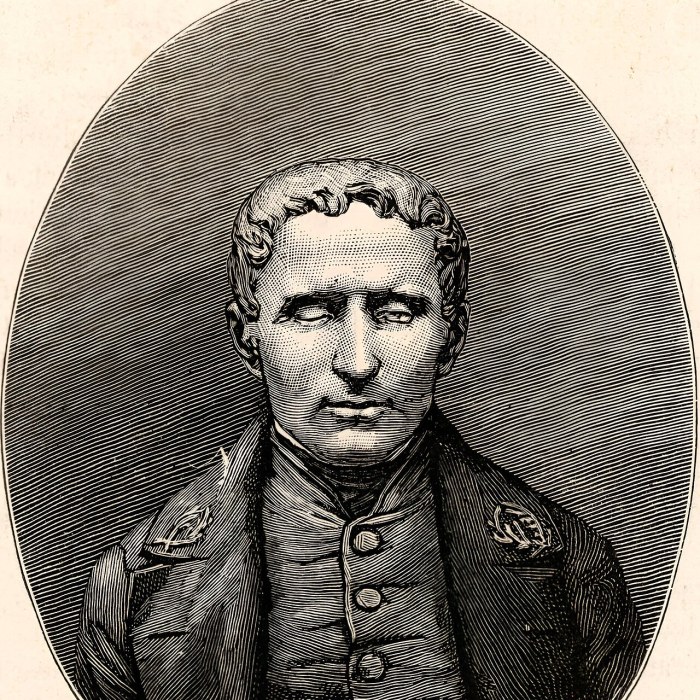
Louis Braille
Blinded at three in his father's workshop, he invented at fifteen the alphabet blind people still read with
Louis Braille was born in 1809 in Coupvray, a village east of Paris, where his father made harnesses and saddles. At three, playing in the workshop, he tried to punch a hole in a piece of leather with an awl. It slipped and went into his eye. The wound became infected, the infection spread to the other eye, and by five he was completely blind.
His parents did not hide him away. He went to the village school, learned by listening, and at ten was sent to the Royal Institute for Blind Youth in Paris, one of the first schools of its kind. It was damp, the food was poor, and its books were printed in huge embossed Latin letters that had to be traced slowly with the finger. The whole library was a handful of volumes.
In 1821 a former army officer, Charles Barbier, showed the school a code of raised dots he had devised for soldiers to pass messages in the dark. It used up to twelve dots per symbol and represented sounds rather than letters. Braille, then twelve, set about improving it. By fifteen he had cut it to six dots, small enough to be read with one touch of a fingertip, and mapped it onto the alphabet. He later added notation for music and mathematics and published the system in 1829.
He taught at the institute for the rest of his life. The school was slow to accept his code and for a time discouraged it, but the pupils taught it to each other. He died of tuberculosis in 1852, aged 43, two years before France adopted it officially.