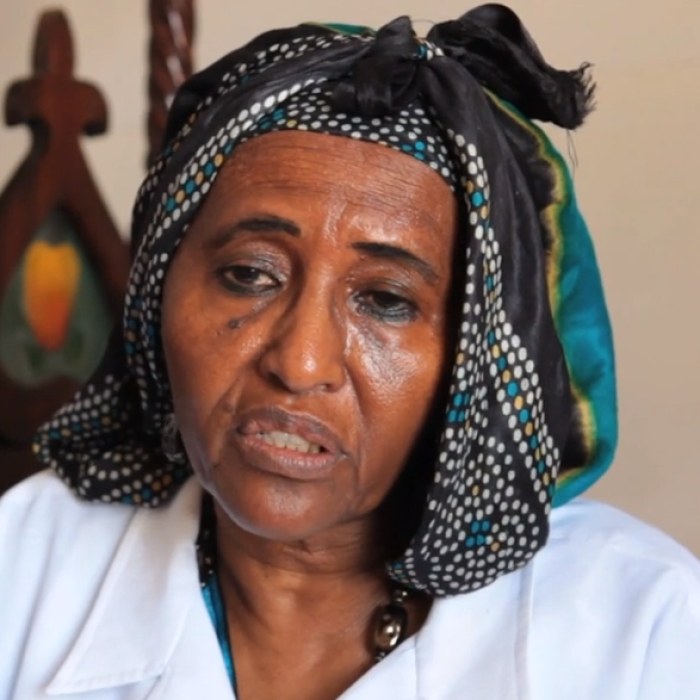
Hawa Abdi
Turned her family farm into a refuge for 90,000 people through Somalia's civil war
Hawa Abdi watched her mother die in childbirth when she was twelve, and decided then to become a doctor. She won a scholarship to study medicine in the Soviet Union, trained as a gynaecologist in Kyiv, and returned to Somalia in the early 1970s as one of the country's first female specialists.
In 1983 she opened a one-room clinic on her family's farmland outside Mogadishu, seeing women who could not afford the city hospitals. When the government fell in 1991 and Mogadishu tore itself apart, families fleeing the fighting arrived at her gate. She let them in. The clinic became a hospital, the fields a camp, and at its height around ninety thousand people were living on her land, most of them women and children.
She set two rules: no one could talk about clan, and no man could beat his wife. Those who broke them were locked up until they promised to behave. She added a school, a feeding centre and a fishing project, and ran the place through famine, droughts and shifting militia frontlines, with her daughters Deqo and Amina, both doctors, working alongside her.
In 2010 fighters from an Islamist group stormed the camp, wrecked the hospital and held her for days, telling her a woman could not run such a place. She refused to leave and demanded a written apology, which she got. She was nominated for the Nobel Peace Prize in 2012 and died in 2020.