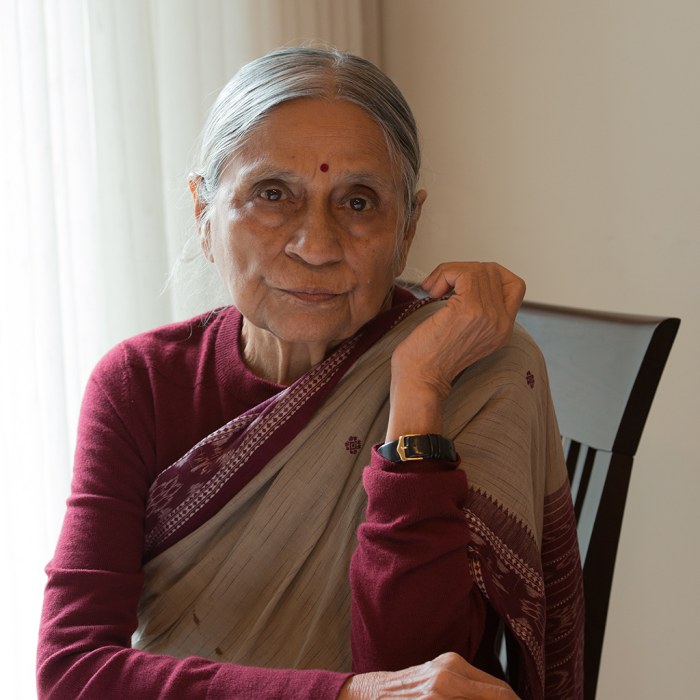
Ela Bhatt
Organised India’s poorest working women into a union and a bank when no one thought they counted as workers
Ela Bhatt was born in 1933 in Ahmedabad into a comfortable family of lawyers, and grew up in the Gandhian atmosphere of Gujarat. She studied law and in 1955 joined the legal department of the Textile Labour Association, the mill workers' union that Gandhi had helped found. Her husband Ramesh, a fellow student activist, was her partner in everything that followed.
In the 1960s the mills were closing and she was sent to look at what happened to the families. She found the wives had always been working, as head-loaders in the cloth market, cart-pullers, vegetable sellers and home-based stitchers, earning a few rupees a day with no contracts, no rights, and moneylenders taking most of it. Nobody counted them as workers. In 1972 she registered the Self-Employed Women's Association, SEWA, as a trade union, and had to fight the registrar, who could not see how a union could exist without an employer.
The members' most pressing problem was credit. Banks would not deal with illiterate women who could not sign their names, so in 1974 four thousand of them put in ten rupees each and started their own bank. SEWA Bank took photographs for identification instead of signatures and sent staff to collect deposits in the market. It has never needed a bailout.
SEWA grew into a federation of cooperatives, childcare, insurance and housing, with over two million members. Bhatt won the Ramon Magsaysay Award in 1977, served in the upper house of parliament, and was one of the Elders founded by Nelson Mandela. She died in 2022, aged 89.