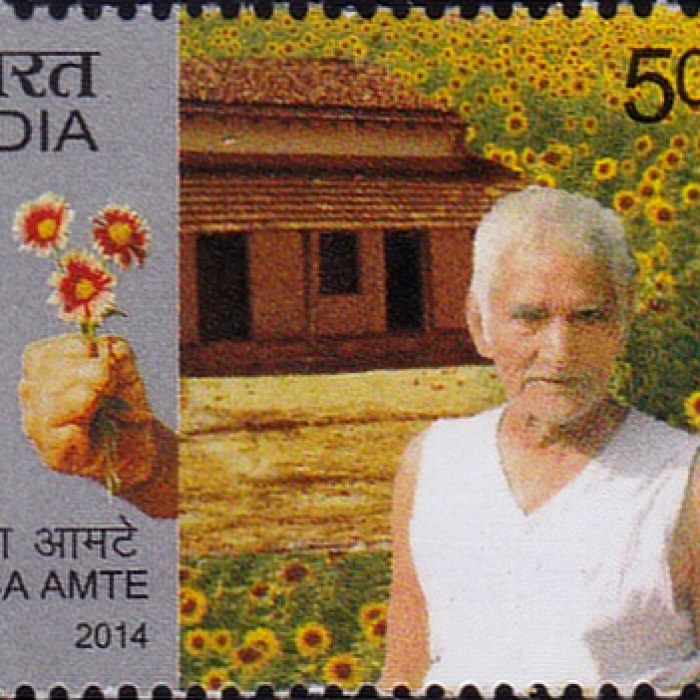
Baba Amte
A rich young lawyer who fled from a leper in the rain, then gave his life to leprosy patients
Murlidhar Devidas Amte was born into a wealthy landowning Brahmin family in Maharashtra and grew up with a sports car, a taste for hunting and film. He trained as a lawyer and practised successfully, but was drawn to Gandhi's movement, gave up his practice and worked among the scavengers of his home town, carrying baskets of night soil himself to shame his own disgust.
One night, walking home in the rain, he came across a man with advanced leprosy lying in a gutter, fingers gone, maggots in his wounds. Amte ran. The memory of running tormented him. He went back, carried the man home and nursed him until he died, and then took a course in leprosy at the Calcutta School of Tropical Medicine. He volunteered to have leprosy bacteria injected into himself in a trial of a vaccine, to test his fear and to learn whether the disease could be caught that way.
In 1949, with his wife Sadhana, two small sons, six leprosy patients and a lame cow, he settled on a stretch of rocky land near Warora that the government had granted him, and began clearing it. He called it Anandwan, the forest of joy. The rule was that nobody would be a beggar or a patient only: everyone who could would work. It grew into a community of thousands with farms, workshops, schools and a hospital, and later a college.
A spinal condition kept him lying flat for much of his later life, from which he still campaigned. He received the Ramon Magsaysay Award in 1985 and the Templeton Prize in 1990, and died at Anandwan in 2008.