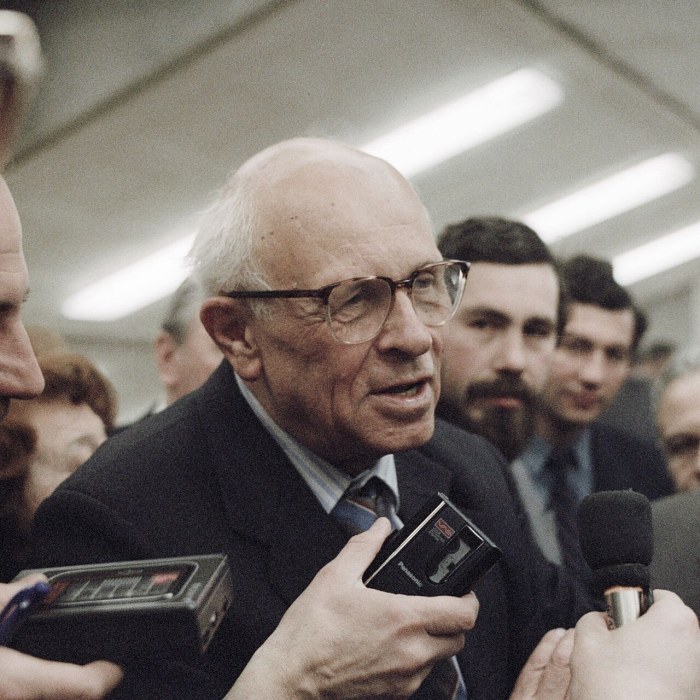
Andrei Sakharov
Built the Soviet hydrogen bomb, then spent twenty years fighting the state that gave him everything
Andrei Sakharov was born in Moscow in 1921, the son of a physics teacher, and by his early thirties was the leading designer of the Soviet hydrogen bomb, first tested in 1953. He was made a Hero of Socialist Labour three times and given a dacha, a car and a level of comfort almost unknown in the country. He was, he said later, convinced he was serving the cause of peace by balancing American power.
Doubt grew from the fallout. He calculated how many people each test would kill over the generations, and in 1961 argued to Khrushchev's face against a 50-megaton test. He was rebuffed, but helped bring about the 1963 treaty that ended atmospheric testing. In 1968 he circulated an essay calling for intellectual freedom and East-West convergence; when it was published abroad he was stripped of his security clearance and sent back to pure physics. In 1970 he co-founded a Committee on Human Rights and began attending the trials of dissidents, standing outside courtrooms in the snow when he was not let in.
He won the Nobel Peace Prize in 1975. The government would not let him leave; his wife, Yelena Bonner, read his lecture in Oslo. In 1980, after he condemned the invasion of Afghanistan, he was seized and exiled to the closed city of Gorky, where he was watched around the clock and force-fed during hunger strikes.
Gorbachev telephoned to release him in December 1986. He was elected to the new parliament in 1989 and argued for democracy until his death that December.